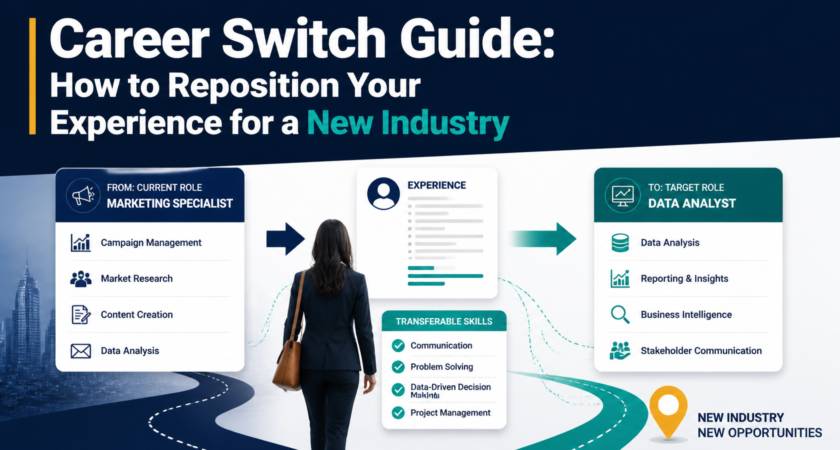
Changing careers can feel like starting over. It isn’t. Most of what you’ve learned is transferable, and the real challenge is presenting it so a new industry can see its value. This guide shows you how to reposition your experience step by step.
Why career switchers get rejected
Employers and ATS software look for familiar patterns: matching titles, matching keywords, matching industries. If your resume reads like it belongs to your old field, it gets filtered out, even when you have the skills.
The fix isn’t hiding your past. It’s translating it.
Step 1: Choose a clear target
“I want a change” isn’t a target. Pick a specific role in your new industry, for example “Business Development Executive in EdTech.” Research 5-10 job postings for that role to understand what employers expect.
Step 2: Identify your transferable skills
Look for skills that travel across industries:
- Communication and presentation
- Customer handling and relationship building
- Negotiation and persuasion
- Project and time management
- Data analysis and reporting
- Problem-solving and leadership
Write down specific examples of each from your past roles. A teacher who explains complex ideas, a customer-support agent who resolves conflicts, and an operations coordinator who manages deadlines all hold skills that sales and business roles value.
Step 3: Find your gaps honestly
Compare the job postings with your skills list. Mark what you have, what you can show in a different form, and what’s truly missing. Missing items become your learning plan.
Doing this across several postings takes time. Scan your resume at careerscan.app to see how your current profile matches the role you want and which skills to emphasize or build.
Switching fields? Check how your resume reads to your target industry at careerscan.app before you apply.
Step 4: Rewrite your resume for the new industry
Lead with a career-change summary. Example: “Customer-focused professional with 4 years of client relationship experience, transitioning into business development with strengths in communication, negotiation, and lead follow-up.”
Reframe your bullets. Describe achievements in the language of your target field. Before: “Handled student queries and enrolments.” After: “Managed 50+ prospective student inquiries weekly, converting enquiries into enrolments through consultative conversations.”
Reorder your resume. Consider a skills-first or hybrid format that highlights transferable strengths before job titles.
Include bridge projects. Courses, freelance work, volunteering, and personal projects show commitment and give you relevant proof.
Step 5: Fill gaps with fast, visible learning
You don’t need a new degree. Short certifications, online courses, and small real projects can close many gaps. Prioritize skills that appear in most job postings, and add them to your resume as soon as you’ve used them.
Step 6: Network into the industry
Many career switches succeed through people, not portals:
- Message professionals in your target role and ask for a brief chat
- Join industry communities and events
- Share what you’re learning on LinkedIn
- Ask for referrals once you’ve built a connection
Step 7: Prepare your story
Interviewers will ask, “Why the change?” Have a short, positive answer:
- What you did and learned before
- Why the new field excites you
- How your background gives you an edge
Focus on what you’re moving toward, not what you’re running from.
Common mistakes to avoid
- Listing every old duty without translating it
- Applying to roles with no connection to your skills
- Hiding your background instead of reframing it
- Expecting overnight results. Switches take persistence.
- Skipping tailoring for each application
Final thoughts
Your experience isn’t wasted. It’s raw material. With a clear target, honest gap analysis, and a resume written for your new industry, a career switch is very doable.
Ready to start? Scan your resume at careerscan.app and see how it stacks up for your next career.