Behavioural questions start with “Tell me about a time when…”. Interviewers use them because past behaviour is the best predictor of future behaviour. They are not looking for a perfect story. They want a real one, told clearly, with your own role and a result.
The STAR method
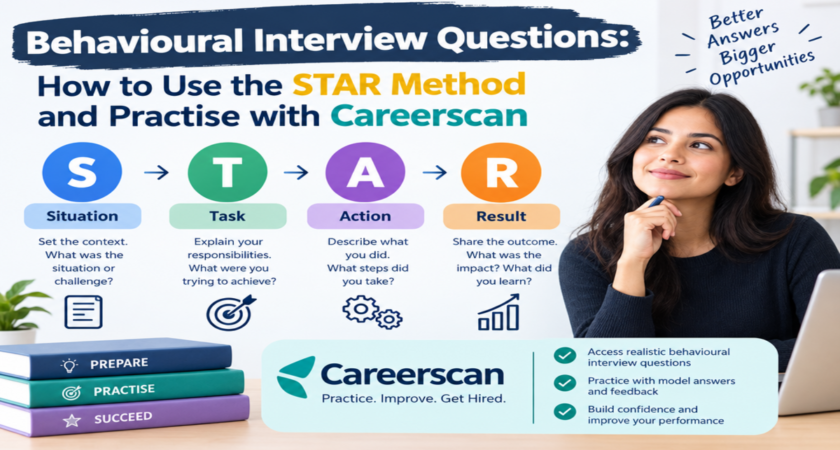
Structure every answer with four parts:
- Situation: the context, in one or two sentences.
- Task: what you were responsible for.
- Action: what you did, step by step. This is the longest part.
- Result: the outcome, with a number if you can, and what you learned.
First questions to prepare
1. Tell me about a time you faced a difficult challenge. Pick a real problem, show your reasoning, and end with a clear result.
2. Tell me about a time you worked in a team and disagreed with someone. Focus on listening, finding common ground and the outcome, not on who was right.
3. Tell me about a time you failed. Choose a real failure, own your part, and explain what you changed afterwards.
4. Tell me about a time you took ownership beyond your role. Show initiative and the impact it had.
Rehearse your stories out loud
A story that sounds good in your head can ramble when you say it. The fix is practice with real questions and honest feedback, which is what Careerscan offers.
Careerscan includes behavioural and HR interviewers on its panel. They ask about teamwork, ownership, conflict and motivation, one question at a time, by voice or text, and follow up when your answer is vague or leaves out your own role.
- Questions shaped by your resume and the role, not a generic list
- A report that scores each answer on 8 criteria and quotes your own words
- Clear notes on what a strong answer would have included
- A follow-up interview to check your progress
Not sure how your stories sound? Start free on Careerscan (15 free credits, no card needed)
More questions to prepare
5. Tell me about a time you handled a tight deadline or pressure. Show how you prioritised, communicated and delivered.
6. Tell me about a time you received difficult feedback. Show that you listened, acted on it, and improved.
7. Tell me about a time you led or influenced others without authority. Focus on how you earned trust and got people moving in the same direction.
8. Tell me about a time you made a mistake at work. Own it, explain how you fixed it, and say what you now do differently.
Mistakes to avoid
- Talking only about “we”, so the interviewer cannot tell what you did.
- Telling a story with no result.
- Blaming others or complaining about past employers.
- Choosing a story that is too small, with no challenge in it.
- Memorising word for word, which sounds robotic.
- Rambling, so aim for about two minutes per answer.
The bottom line
Prepare five or six strong stories from your own experience and learn to adapt each to several questions. Practise telling them out loud until they sound natural.
Walk in calm and ready. Start your free Careerscan interview and practise your stories before it counts.