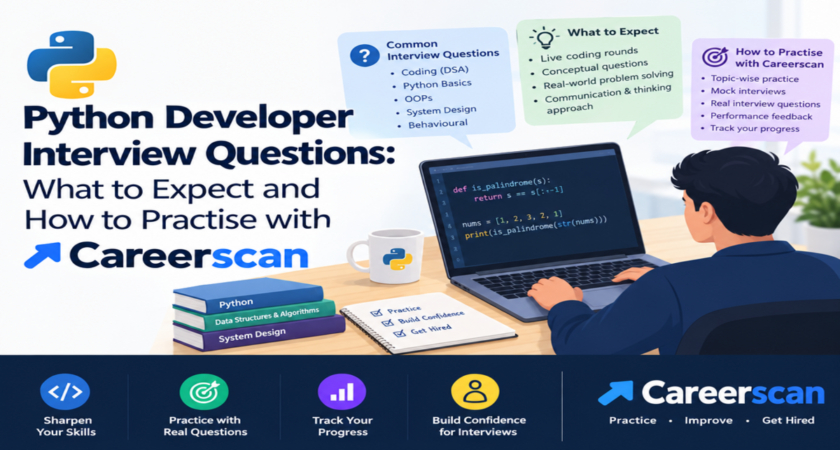
Python is easy to start and hard to master, and interviewers know it. Many candidates can write a script, but fewer can explain why their code works, how it performs, and how they structured a real project. That gap is exactly what a Python interview probes.
Expect questions on language fundamentals, data structures, a framework such as Flask, Django or FastAPI, and the projects on your resume. Here are the core questions to be ready for.
Core Python questions
1. What is the difference between a list and a tuple? Lists are mutable and tuples are immutable. Go one step further and explain when immutability helps, such as using a tuple as a dictionary key.
2. How do Python dictionaries work? Mention hashing, average constant-time lookups, and that keys must be hashable. This question often leads to follow-ups on collisions and ordering.
3. What are decorators and when would you use one? Explain that a decorator wraps a function to add behaviour, then give a real use such as logging, authentication or caching.
4. What is the difference between a generator and a list? Generators produce values lazily, which saves memory for large data. Give an example of reading a large file line by line.
5. Explain the GIL. The Global Interpreter Lock lets only one thread run Python bytecode at a time. Show you know the practical impact: threads help for I/O-bound work, while multiprocessing suits CPU-bound work.
6. What is the difference between shallow and deep copy? Use a nested list to show how a shallow copy shares inner objects.
Practise these questions the way a real panel asks them
Knowing the answers on paper is different from giving them out loud with someone listening. Careerscan lets you practise the real thing before the real thing.
Careerscan reads your resume against the Python role you want, then interviews you on it. A Python specialist interviewer asks about the skills the job needs and the projects you list, for example: “You mention a Django app with 50,000 monthly users. What was the hardest scaling problem, and how did you solve it?” If your answer is thin, it follows up.
- Questions built from your resume, the job’s skills and what the company is known to ask
- Voice or text answers, one question at a time
- A report that scores every answer on 8 criteria and quotes your own words
- A short lesson and practice round for each gap it finds
Ready to test yourself? Start free on Careerscan (15 free credits, no card needed)
Framework and project questions
7. What is the difference between Flask, Django and FastAPI? Compare them honestly: Flask is lightweight and flexible, Django is full-featured with an ORM and admin, and FastAPI is built for fast, typed APIs. Say which you used and why.
8. What is an N+1 query problem and how do you avoid it? A classic backend question. Explain how one query per related row slows an app, and how eager loading or joins fix it.
9. How do you handle caching and database indexing? Name what you cached, for how long, and how indexes sped up slow queries.
10. Tell me about the hardest problem you solved in a project. Describe the problem, what you did yourself, and the result with numbers if possible.
How to answer well
- Start with a direct answer, then add detail.
- Use your own project as the example.
- Say “I” for what you did, not only “we”.
- Give before-and-after results wherever you can.
- Admit what you do not know, then explain how you would find out.
The bottom line
Python interviews reward clear thinking and real examples over memorised definitions. Learn the concepts, then practise explaining them on questions that come from your own projects.
Find your gaps now, not in the interview room. Start your free Careerscan interview and walk in already practised.