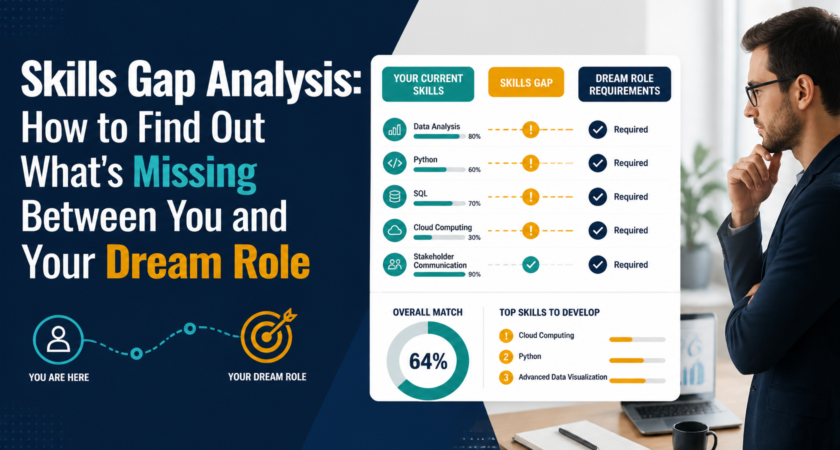
You know the job you want. You’ve read the postings. But every time you apply, the same question nags: Am I actually qualified? A skills gap analysis answers that question with evidence instead of anxiety.
What is a skills gap analysis?
It’s a simple comparison between what a role requires and what you currently offer. The difference between the two is your gap, and once you can see it, you can close it.
It’s useful whether you’re a fresher, switching careers, or aiming for a promotion.
Step 1: Define your target role
Be specific. “Sales” is vague; “Business Development Executive at a SaaS company” is something you can work with. Pick one to three target roles so your analysis stays focused.
Step 2: Collect real requirements
Gather 5-10 job postings for that role and note:
- Skills that appear in most postings (these are your core requirements)
- Skills that appear occasionally (nice-to-haves)
- Tools and software named
- Experience level and qualifications expected
Patterns matter more than any single posting. If eight of ten listings mention CRM tools and lead generation, those aren’t optional.
Step 3: Inventory your own skills
List everything you can do, including skills from internships, college projects, volunteering, and part-time work. Divide them into:
- Technical / tool skills (Excel, CRM platforms, presentation software)
- Domain skills (lead generation, market research, client communication)
- Soft skills (negotiation, persuasion, adaptability)
Be honest. Overrating yourself hides the gap, and underrating yourself hides your strengths.
Step 4: Compare and score
Build a simple table with three columns: Required skill, Your level (0-3), Priority. Anything scoring 0 or 1 on a core requirement is a gap worth closing first.
Doing this by hand across several job postings is slow, and it’s easy to miss keywords. A faster route: upload your resume at careerscan.app to see how your profile lines up against the roles you want and which skills are missing.
Skip the spreadsheet: Get a clear view of your strengths and gaps in seconds at careerscan.app.
Step 5: Build a closing plan
For every gap, pick one concrete action and a deadline:
| Gap | Action | Timeline |
|---|---|---|
| CRM tools | Complete a free CRM certification | 3 weeks |
| Cold outreach | Practice with 20 mock outreach emails | 2 weeks |
| Data reporting | Learn Excel pivot tables | 10 days |
Small, dated actions beat vague goals like “improve my skills.”
Step 6: Prove it on your resume
Closing a gap only helps if employers can see it. Add new certifications, projects, and results to your resume using the language from job postings. Then re-check your resume to confirm the improvement.
Step 7: Repeat every few months
Job requirements evolve. Re-run your analysis every quarter to stay current and keep your progress visible.
Common mistakes to avoid
- Chasing every skill instead of the core ones
- Collecting certificates without applying the skills
- Ignoring soft skills, which employers weigh heavily
- Waiting until you feel “100% ready” before applying (most hires meet only part of the listed requirements)
Final thoughts
A skills gap analysis turns a vague worry into a clear checklist. Know where you stand, close the gaps that matter, and show your progress.
Start with step one today: scan your resume at careerscan.app and find out what’s standing between you and your dream role.