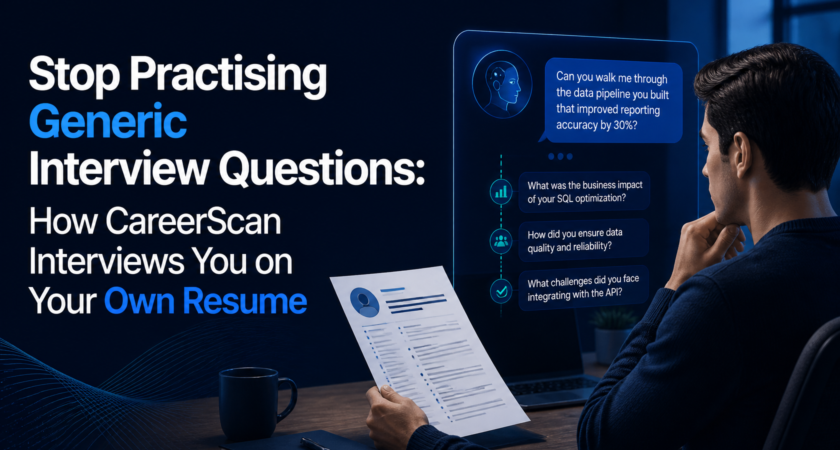
If you’ve prepared for an interview by reading a list of “Top 50 Common Questions,” you’ve probably noticed the problem: the real interview rarely matches the list. Interviewers read your resume, pick out your projects and skills, and ask about those. Preparation that ignores your own resume leaves you guessing.
Why generic question lists fall short
Common question lists have real value for basics like “Tell me about yourself.” But they miss three things that decide most interviews:
- Your specific resume. An interviewer who sees “Built a REST API in Spring Boot” will ask how you handled validation and errors, not a textbook definition of REST.
- The specific job. A backend role and a data analyst role test different skills, even at the same company.
- Your experience level. A fresher and a senior engineer should never get the same interview.
Reading answers is also passive. You can nod along to a model answer and still freeze when asked the question out loud.
What a better way to practise looks like
Good practice has four ingredients:
- Questions based on your resume, so you rehearse the conversation you’ll really have
- Questions based on the job’s skills, so you cover what the employer cares about
- One question at a time, with follow-ups, because real interviewers dig when an answer is thin
- Honest feedback, so you know what to fix
How CareerScan interviews you on your own resume
CareerScan is built around that idea. You tell it the role, the company and the country, and it reads your resume against the job. Then it interviews you.
- Questions come from four places: the projects and skills on your resume, the skills the job needs, what the company is reported to ask, and your experience level. Two people applying for the same job get different interviews.
- A panel of specialists asks the questions. Depending on the role, that could include technical interviewers (Java, Python, data and SQL, cloud, system design and more), a role specialist, and behavioural and HR interviewers who take turns.
- You answer by voice or by typing, one question at a time. Follow-up questions appear when an answer is thin, like a real panel.
- You get a detailed report that scores every answer, quotes your own words, and says what a strong answer would have included.
Try your own interview: Every new CareerScan account starts with 15 free credits, enough for a resume analysis and a full interview with its report. No card needed. Start free at careerscan.app
An example of the difference
Here’s an illustrative example of how a resume-based question works. Suppose your resume says:
“Built a Django app serving 50,000 monthly users.”
A generic list would never ask about this. A resume-based interviewer might ask:
“What was the hardest scaling problem, and how did you solve it?”
Say you answer: “Pages got slow as usage grew, so we added caching and optimised some queries. After that it was much faster.”
That sounds reasonable, but it’s thin. A stronger answer would name which queries were slow and how you found them, what you cached and for how long, the before-and-after response times, and what you did rather than what “we” did. That gap between a decent answer and a strong one is exactly what practising on your own resume reveals.
From practice to improvement
Practice only helps if it leads somewhere. After your interview report, CareerScan turns each weak spot into a short lesson with a quick understanding check and practice questions. You can then take a follow-up interview to see whether you’ve improved, and move up from Basic to Intermediate to Advanced.
Tips for getting the most from a practice interview
- Treat it like the real thing. Answer aloud if you can, and don’t pause to look things up.
- Use a real job. Practise for the role and company you’re actually applying to.
- Give examples. Use specifics, numbers and what you personally did.
- Read the report slowly. Focus on the top two or three gaps, not every point.
- Repeat. One round shows your weak spots. A second round shows progress.
A note on privacy
Your resume and answers are private. Only you see them, and they aren’t shown to administrators or institutions. You can download or delete everything from your profile at any time.
Final thoughts
No tool can promise you the job. But you can walk in knowing your weak spots instead of discovering them in the room. Practising on your own resume, for your own target role, is the closest you can get to a rehearsal.
Ready to see how your interview would go? Start free at careerscan.app and find your gaps before the interviewer does.